
You know what annoys me most when I go for a walk? Those dogs that pull on their leashes like they're trying to compete in the Vendée Globe. And their owners behind them, arms outstretched, wondering if they're going to end up in the emergency room with a dislocated shoulder.
Dog walking should be cool, right? A moment where you and your furry friend just enjoy being outside together. No stress, no pulling, no yelling.
Go to the park on a Sunday morning, you'll see the show. The Husky weaving through everyone. The little Cavalier King Charles standing there, refusing to move. The overexcited Golden Retriever jumping on the joggers. It's chaos, basically.
In this guide, we're going to talk about walks. But not the basic "take your dog out three times a day and you're good to go" kind of thing. No, we're really going to delve into how to make those moments amazing. Because yes, walking your dog with style and efficiency is totally doable.
Why Walking Your Dog Is Much More Than Just Going Outside to Pee
Okay, let's face it. A lot of people take their dogs out just to relieve themselves. Five minutes flat on the sidewalk, mission accomplished, back home.
Wait. Is this really your dog's life?
The walk is his special time. It's when he truly becomes a dog again. He sniffs everything, takes in a million things with his nose, and meets up with his canine friends. All of which makes your companion more than just a snoring cushion on the sofa.
Take my neighbor, for example. He has a Border Collie. A real live wire. For six months, he took it out for fifteen minutes in the morning and fifteen minutes in the evening. That's it. The dog started chewing up the living room cushions. Typical, you might say. A Border Collie kept indoors all day is like locking a marathon runner in a closet. It's bound to go flat.
Keeping a Border Collie cooped up all day is like trapping a marathon runner in a closet. It's a disaster. But since he changed his routine—a minimum of one hour per outing with real freedom to sniff around and romp—the dog has completely transformed. He's calm at home and also very happy. The transformation is incredible.
The physical aspect: It's for health
Of course, walking your dog is exercise while preventing weight gain, and it also keeps their heart and joints healthy. Sporty breeds, like Malinois, Retrievers, and Dalmatians, really need to expend their energy, not just a short stroll around the block; they need proper runs where they can trot, sprint, and explore thoroughly.
The Mind: The Key to Essence
What truly tires a dog isn't just running or other sports; it's its brain working overtime. Sniffing different scents, decoding and analyzing the scent trails left by other dogs—all of this can help a dog be ten times more relaxed than on a walk in an empty field. The other day at the park, I saw a Beagle sniffing everywhere with its owner's permission, taking its time and exploring every nook and cranny. And half an hour later, this Beagle was completely zen, tongue lolling as it strolled along, its goal achieved.
You and Your Dog: Enjoying Moments Just for You
Walking your dog is something you both enjoy. No cell phones, or at least fewer calls, since these are moments for the two of you to share. It's about building trust between you. Your dog learns to follow you, come when you call, and walk calmly beside you. And you? You also have to learn to understand your dog and pick up on its signals. My sister adopted a Whippet two years ago. This dog was stressed but energetic at first.
She established a routine: every evening, an hour-long walk in the same park. Gradually, the dog opened up. Today, he runs freely, comes when called, and interacts with other dogs. All thanks to the regularity of these walks.
How Often and For How Long Should You Walk Your Dog?
Now, I can already hear people saying: "I don't have time for hours of walking every day!" OK, I understand. But there are still certain minimums to respect.
The Basic Rule: Three to Four Outings Per Day Minimum
An adult dog needs to go out at least three times a day. Ideally four. That may seem like a lot, but wait. These outings don't all have to be two-hour expeditions.
In the morning, a twenty- to thirty-minute walk for bathroom breaks and a little exercise. The same duration at midday. In the evening, that's the real walk: a minimum of forty-five minutes to an hour. And before bedtime, a short ten-minute walk.
Okay, I know. It's a commitment. But that's what having a dog entails.
Adaptable according to age: Puppy, Adult, Senior
Puppies have a bladder the size of a walnut. They need to go outside very often, like every two hours when they're very young. But be careful, no long walks. Their joints are still fragile. Fifteen minutes max per session is enough.
A healthy adult dog can easily handle an hour, or even two hours, of walking. Sporting breeds require even more.
Senior dogs, on the other hand, slow down. Their pace changes. Shorter but more frequent walks work better. My brother-in-law has a twelve-year-old Labrador. They go out four times a day for twenty minutes each time. The dog is happy that way.
Adapting According to Race: Not All Are Equal Before Exercise
A Jack Russell doesn't have the same needs as a French Bulldog. Makes sense.
Sporting breeds – Australian Shepherds, Border Collies, Setters, Belgian Malinois – need at least two hours of exercise a day. Even more if possible. These dogs are like machines. Leaving them confined without proper exercise is a sure way to develop behavioral problems.
Brachycephalic breeds like Pugs or Bulldogs do not tolerate prolonged exertion well. Twenty to thirty minutes is sufficient, especially in hot weather.
My former colleague had a Cavalier King Charles Spaniel. She thought fifteen minutes was enough. The dog developed anxiety problems. Since she doubled the length of the walks, everything is better.
Where to Walk Your Dog? The Best Places for Successful Walks
Frankly, the choice of location makes absolutely everything. Walking your dog on the same gray sidewalk all the time is guaranteed to be boring. For him as well as for you.
Dog Walking in the City: Adapting to the Urban Context
Living in the city with a dog is possible. But you have to be clever.
Urban parks are your best allies. Look for those with green spaces large enough for your dog to explore. Even on a leash, he'll enjoy the smells and the grass under his paws.
Be careful though. In town, dogs are often required to keep their dogs on a leash. Respect this. Not just because of the law, but also for your dog's safety. Cars, bikes, distracted pedestrians… Dangers are everywhere.
 Urban strolling requires suitable and stylish accessories.
I have a friend who lives in Paris with a German Shepherd. She's discovered all the little squares in the neighborhood. She varies her routes every day. Her dog loves it. Every outing is a new adventure.
Countryside and Forest Walk: Canine Paradise
Ah, the forest. The ultimate playground for a dog.
If you have access to natural spaces, make the most of it. Letting your dog off-leash in the woods (when it's allowed and safe) is giving them the very best. They can run, sniff, and explore at their own pace.
 Parks offer an ideal space for mental and physical stimulation.
However, be careful. During game breeding season, keep your dog on a leash. Respect wildlife. And watch out for ticks. After every walk in the woods, thoroughly inspect your dog's coat.
My cousin lives near a forest. Every weekend, he takes his Springer Spaniel for a long walk. The dog comes back covered in mud, exhausted, but happy. That's what a dog's life is all about.
Dog Parks: Socialization and Freedom
Dog parks, those dedicated spaces where dogs can run off-leash, are great. In theory.
In practice, it's essential to ensure that all dogs present are well-socialized. An aggressive dog in a park can ruin everyone's outing.
If your dog is with other dogs, to communicate, to play.
Hey, the other day at the dog park near my house, I saw a magnificent Dalmatian with a bright red collar. The dog was running with a pack of canine friends. Honestly, it was beautiful to see.
Dog Walking According to the Seasons: Adapted for Comfort and Safety
The seasons change, and your way of walking your dog should adapt as well.
Walking Your Dog in Summer: Beware of the Heat
Summer is a trap. Temperatures rise, and dogs don't sweat like we do. They regulate their temperature by panting. Not very efficient when it's 35°C.
 In summer, opt for walks early in the morning or late in the evening.
Rule number one: walk your dog early in the morning or late in the evening. Absolutely avoid the hottest hours.
Always test the ground with your hand. If it's too hot for your palm, it's too hot for your dog's paws. Asphalt in direct sunlight can reach 60°C. That's scorching.
Constant hydration. Bring water, offer it regularly.
My friend has a French Bulldog. In the summer, he only goes out at 7 a.m. and after 9 p.m. The rest of the day, the dog stays indoors.
Winter Walk: Protecting from the Cold
In winter, it's the opposite. Some breeds love the cold – Huskies, Newfoundlands, Saint Bernards. Others suffer – Chihuahuas, Greyhounds, short-haired breeds.
For them, a coat is not a fashion accessory. It's real protection.
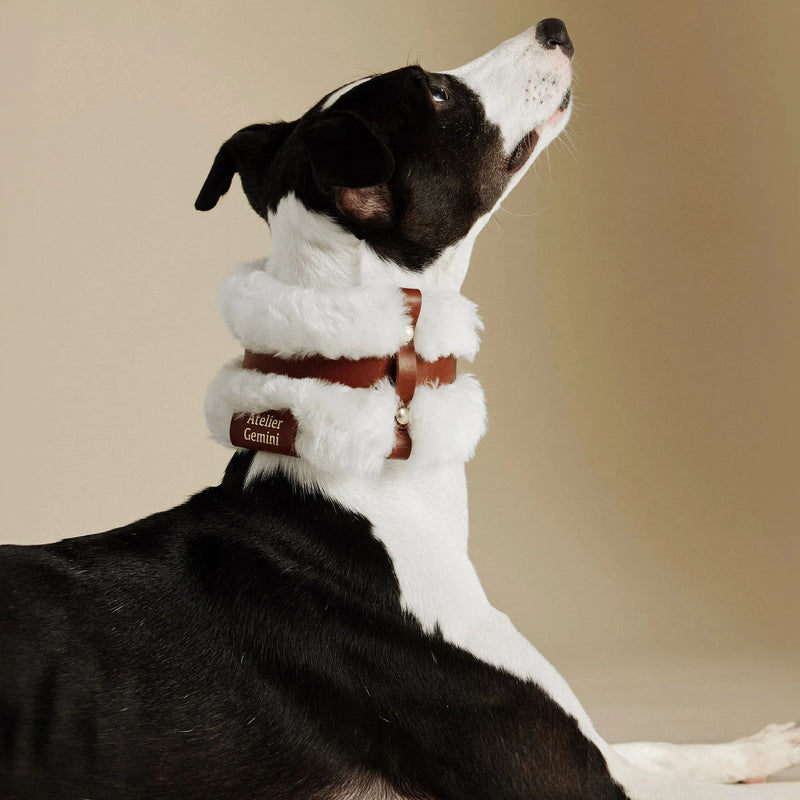
Leather and Sheep's Wool Necklace
Check out this leather and sheepskin collar. The wool provides an extra layer of warmth around the neck, and the leather stays supple even in cold weather. Perfect for breeds that get cold easily, like Whippets or Greyhounds.
Discover this necklaceBe careful of salt and de-icing products on the sidewalks. They can burn your dog's paw pads. Rinse your dog's paws when you get home.
Rain and Bad Weather: No Excuse to Skip the Walk
Let's be clear. Your dog needs to go outside, rain or shine.
Okay, obviously, if it's a storm with hail and strong winds, we can shorten the hike. But a light drizzle? Come on, let's get our gear on and go.
Most dogs don't mind the rain. Some even love it. My old neighbor had a Springer Spaniel who went wild with joy whenever it rained. The dog would jump in every puddle.
Bring a raincoat for yourself, and if your dog has long hair, bring a towel to dry him when you get home.
Education and Behavior: The Walk as a Learning Tool
A walk is also an educational opportunity. There's no need to turn it into a lecture, but a few principles can help.
Walking on a Leash: Comfort for Both of You
A dog that pulls constantly is a nuisance. For you, for him, for everyone.
 A harmonious progression requires patience and consistency in education.
Teach him to walk calmly beside you. Not necessarily at heel like a show dog, but without pulling like crazy.
The technique? As soon as he pulls, you stop. Instantly. You don't move while the leash is taut. As soon as he releases the tension, you start walking again. It takes patience, but it works.
My cousin did that with his Labrador. The first few walks were long – like, twenty minutes to go a hundred meters. But after three weeks, the dog had figured it out. Now he walks perfectly.
The Reminder: Freedom in Complete Safety
If you want to be able to let your dog off-leash, recall training is non-negotiable.
Train him gradually. Start in enclosed, safe spaces. Call him and reward him generously when he returns. Gradually increase the distractions.
Never call your dog back to scold him. Otherwise, he'll associate being called back with something negative. Bad idea.
My sister worked on recall training with her Whippet for months. Now she can let him off-leash in parks. The dog runs, explores, but comes back as soon as she calls him.
Managing Encounters with Other Dogs
Your dog encounters another dog. What should you do?
Observe the body language of the two dogs. If they are both relaxed, with their tails wagging, you can let them sniff each other. It's their way of getting to know each other.
If either of them shows signs of stress – tail down, growling, bristling fur – calmly move away.
Never let two dogs on leashes run at each other. It creates tension. The leash restricts their natural communication.
 Canine socialization is essential for peaceful walks.
The other day at the park, I saw two owners letting their dogs sniff each other calmly before letting them play. The dogs had a blast for twenty minutes. No problem at all.
Solutions for Very Busy Masters
OK, now we're getting to real life. The one where you work, you have obligations, and walking your dog for two hours a day seems impossible.
Hire a Professional Dog Walker
Dog walkers aren't just for rich people. They're a practical solution for those who are short on time.
A good dog walker takes your dog for thirty to sixty minutes, gives him a real walk, and brings him back exhausted and happy.
Prices vary, but expect to pay between 10 and 15 euros per outing. If you only need it two or three times a week, that's reasonable.
Choose someone reliable, with references. Ideally, someone who takes in a maximum of three or four dogs at a time. Your dog will get more attention.
Applications and Communities
There are apps where you can find walkers or even neighbors who walk their dogs and are willing to take yours.
Some people love walking dogs but don't own one. It's a win-win situation.
My colleague uses this system. A retired woman from the neighborhood comes to pick up her Cocker Spaniel three times a week. The dog loves it, and so does the lady.
Optimize Your Own Outings
If you have to do it yourself with a tight schedule, optimize.
Lunch break: a brisk thirty-minute walk. In the morning before work: twenty-five minutes. In the evening: a minimum of one hour.
That's almost two hours in total. It's doable.
And on weekends, make up for it with some real long walks. Forest, beach, mountains. Your dog will love it.
Mistakes to Absolutely Avoid
Okay, let's talk about what you absolutely shouldn't do.
Always the Same Route
Walking your dog along the exact same route every day is total boredom for him.
Vary your walks. Change parks, take a different street, explore new neighborhoods. Each walk should offer new stimulation.
Don't Let Your Dog Sniff
Some owners constantly pull on the leash as soon as their dog stops to sniff. Mistake.
A dog's sense of smell is its primary sense. It's how it discovers the world. Depriving it of this sense frustrates it.
Let him take his time. Obviously, if you're in a hurry, speed things up a bit. But normally, let him explore.
Walking Too Little or Too Long
Both extremes are bad.
Too little, and your dog will accumulate energy and stress. Too much, especially for young dogs or senior dogs, risks injury.
Adjust according to your dog's age, breed, and physical condition.
Forgetting Hydration
In summer, but also after intense exercise, your dog needs to drink.
Always carry water and a collapsible bowl. Offer it to him regularly.
Dehydration in dogs can be serious. Never neglect it.
Conclusion: Transform Every Walk into an Exceptional Moment
That's it. We've covered everything.
Walking your dog is much more than just a chore to tick off your to-do list. It's the moment when you give your companion what they need most: freedom, exploration, and stimulation.
 The stylish walk combines elegance, comfort and respect for canine needs
This is also your time. Those moments when you disconnect from work, screens, and stress. Just you, your dog, and the world around you.
Invest in good equipment. A quality collar , a comfortable leash, suitable accessories. It really makes all the difference, believe me.
 Don't forget to explore new horizons with your companion.
Vary your walks, adapt them to the seasons, and respect your dog's needs. Above all, enjoy them. These walks are what make your relationship with your dog unique.
So tomorrow morning, when you take your dog out, take five extra minutes. Let him sniff that patch of grass that intrigues him. Admire how happy he is, simply because he's outside with you.
It's worth all the treasures in the world, honestly.
How to Walk Your Dog with Style and Efficiency?
Okay, now that we know why, how long, and where, let's talk about how. Because yes, there is a way of doing it that changes everything.
Equipment: Investing in Quality Changes Everything
Frankly, the right equipment is essential. A poor quality collar that rubs, a leash that's too short, and your walk becomes an ordeal.
The leather collar is definitely my favorite. Why? Because it breathes, softens over time, and develops a unique patina that no one can replicate. My neighbor has a Labrador that's been wearing the same collar for five years. Five years! The leather has taken on a beautiful, slightly darker hue.
Customizable Premium Leather Collar
Look at this premium leather necklace. What I particularly like is the solid brass hardware. Not plated brass that will rust after six months. Real brass that lasts. The top-grain leather is truly the best of the best.
Discover this necklaceHarness or Collar? The Eternal Debate
Well, that really depends on your dog.
For breeds that pull a lot – Huskies, Malamutes, some Shepherds – an anti-pull harness is a godsend. It distributes the pressure across the chest, not the neck. Your dog pulls less, and you suffer less.
For dogs that walk well on a leash, a collar is sufficient. It's lighter and less bulky.
My sister-in-law has an Italian Greyhound. A slender, elegant dog. She uses an orange leather collar. It suits him perfectly.
Leather Necklace with Customizable Medal
This leather collar with an integrated tag is perfect for elegant breeds. The soft leather won't damage their coat, and the tag keeps their contact information visible at all times. Practical and stylish.
Discover this necklaceThe Leash: Finding the Right Compromise
The leash is your physical connection to your dog. It should be pleasant to use.
Personally, I'm not a fan of retractable leashes. They give too much freedom all at once, then suddenly, they lock up. It creates confusion.
I prefer classic leashes of 1.5 to 2 meters. Or 5-meter long lines for spaces where more freedom is allowed.
A good leash should be comfortable in your hand, strong, and suitable for the size of your dog.
Premium Nylon and Leather Leash with Brass Accents
This premium nylon and leather leash with brass details combines strength and elegance. The leather handle prevents chafing, and the nylon is incredibly durable. Perfect for everyday walks and long hikes alike.
Discover this leashEssential Accessories
Dog poop bags. Yes, glamorous. But essential. Always pick up after your dog. It's a matter of respect.
A portable water bottle is essential if you're going away for a long time. Hydration is crucial, especially in summer.
If you walk your dog early in the morning or late in the evening, consider using light-up accessories. LED collars, reflective strips. Your dog will be visible, and that could save its life.