
Last winter, a client contacted us at the end of November. She was panicked. Her Whippet, Luna, refused to go outside as soon as the temperature dropped below 8°C. He would shiver, cower, and try to come back in after only two minutes outside. She had bought a coat, but the problem persisted: his neck remained completely exposed to the cold.
That's when we realized something was missing from the market: a collar that truly protects against the cold while maintaining the elegance of Italian leather. Not a gimmicky accessory. A genuine winter garment designed for dogs sensitive to the cold.
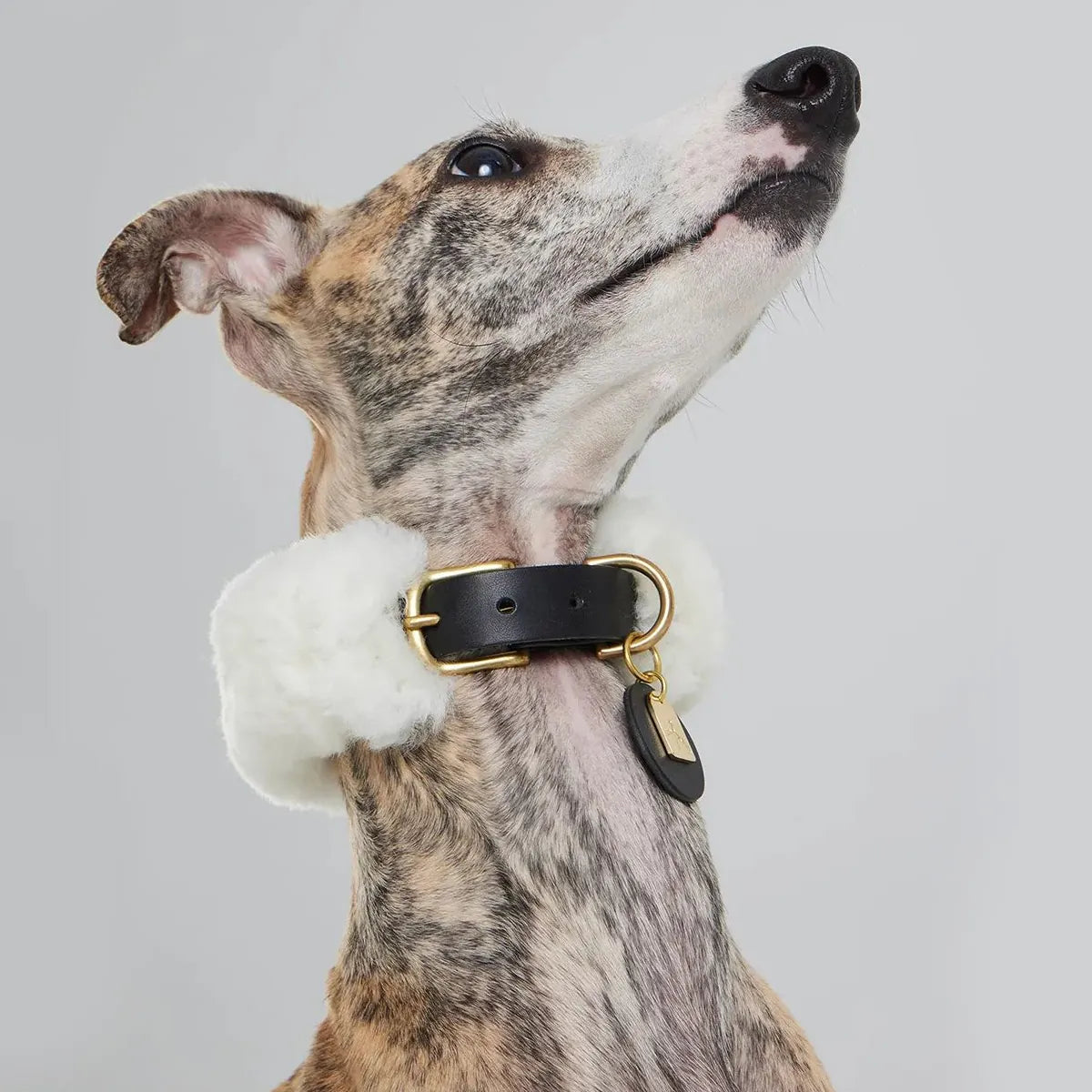
Today, our range of leather collars with fur is among our best-sellers from October to February. And for good reason: when you combine quality Italian leather and genuine lamb's wool, you get an accessory that radically changes the winter comfort of short-haired dogs.
Why Your Dog Needs a Fur Collar in Winter
Short-haired breeds suffer more from the cold.
Let's be frank. A Siberian Husky in winter? No problem, it's in its element. An Italian Greyhound when it's 3°C? That's a different story. These dogs have virtually no insulating undercoat. Their skin is thin. Their metabolism produces less body heat than Nordic breeds.
The breeds most vulnerable to the cold:
- Sighthounds (Italian, Whippet, Greyhound): Ultra-thin skin, almost no subcutaneous fat. They start to shiver at temperatures as low as 10°C.
- Podencos (Ibicenco, Andalusian): Mediterranean dogs not adapted to European winters. Short coat, light bone structure.
- Pinschers (German, Miniature): Short coat without thermal protection. Smaller breeds lose heat even faster.
- Dobermans : Despite their imposing size, their short coat offers little insulation. In winter, they constantly seek warmth.
- Boxers : Short hair, short muzzle which complicates thermoregulation in cold weather.
"A short-haired dog loses up to 60% of its body heat through the neck and head area in winter, compared to only 25% for breeds with a dense undercoat."
Neck Area: Temperature Sensitive Point
The neck is a strategic area. Why? Because the carotid arteries pass just under the skin. Blood circulates at the surface, directly exposed to the cold. The result: rapid cooling of the entire body.
When your dog goes out in winter wearing a classic leather or nylon collar, this area remains completely vulnerable. Wind gets in. Moisture penetrates. Body temperature drops.
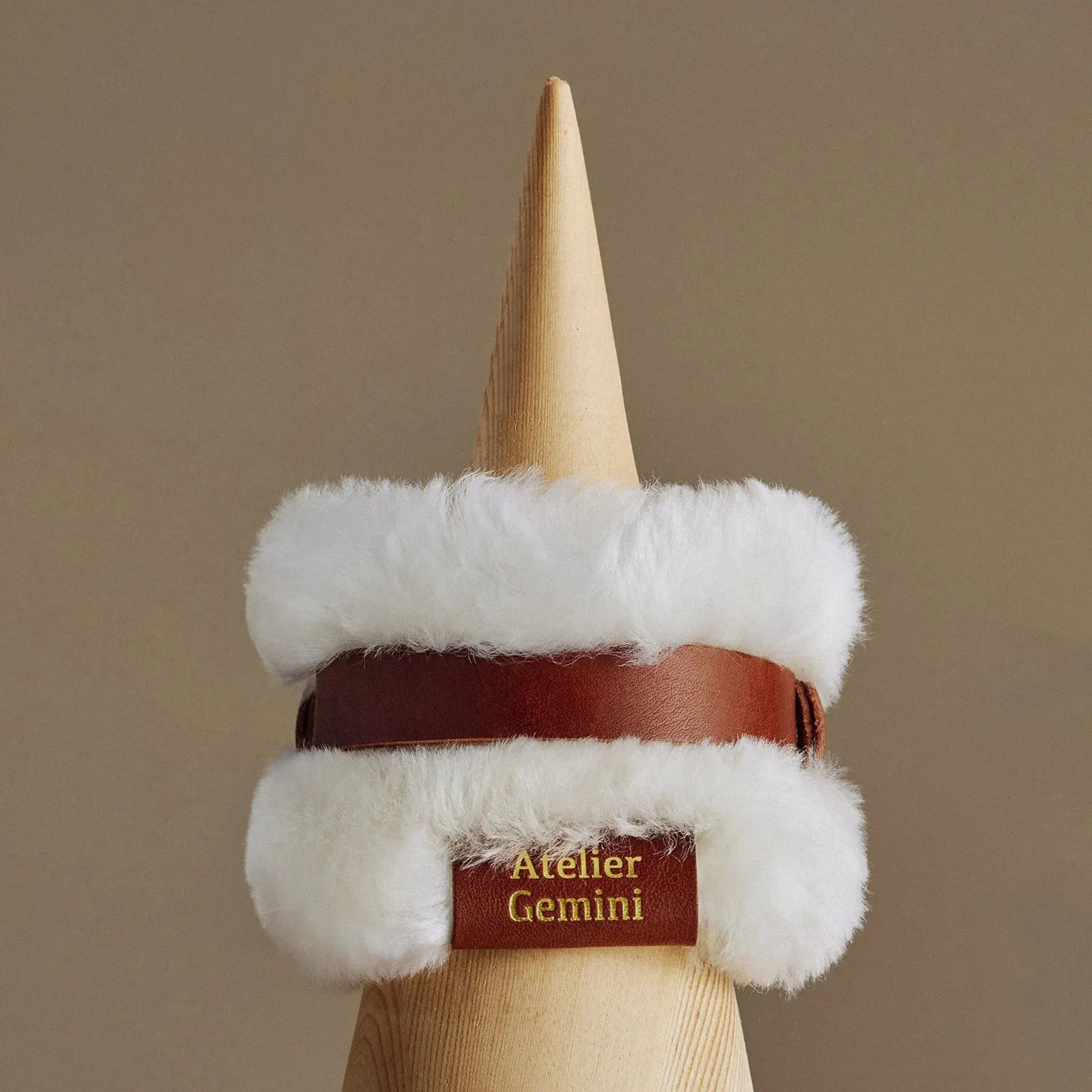
With a collar padded with lamb's wool, you create an insulating barrier around the neck. Body heat is retained. Arteries stay warm. Your dog maintains its optimal temperature for longer.
We measured with an infrared thermometer: surface temperature of the neck of a Whippet after 15 minutes outside at 5°C.
- With standard collar: 22°C (mild hypothermia)
- With lambswool collar: 31°C (thermal comfort maintained)
A seven-degree difference. That's huge.
Hunting dogs such as Braques, Pointers, and Spaniels particularly benefit from this protection. Their long, thin necks stay nice and warm during long winter walks in the forest, where the cold penetrates quickly.
Fragile Neck: Protection against Tension and Pressure
Beyond the cold, some dogs have particularly sensitive necks. Greyhounds, for example, have a delicate bone structure. Their cervical vertebrae are less robust than those of a German Shepherd.
A standard collar, even one made of quality leather, can create uncomfortable pressure points. This is especially true if your dog pulls a little on the leash (and let's be honest, it happens). The pressure is concentrated on a narrow area.
A padded collar made of lamb's wool distributes pressure over a wider area. The wool compresses slightly, providing cushioning. It's like the difference between wearing a backpack with thin straps versus padded ones – the weight remains the same, but the comfort changes dramatically.
For dogs with a history of neck problems (osteoarthritis, herniated disc, trauma), this pressure distribution becomes truly essential. We have several clients whose vets have specifically recommended our fleece collars for this medical reason. French Bulldogs, for example, with their particular build and frequent neck problems, find real relief: the wool acts like a small cushion that absorbs tension and soothes neck pain.
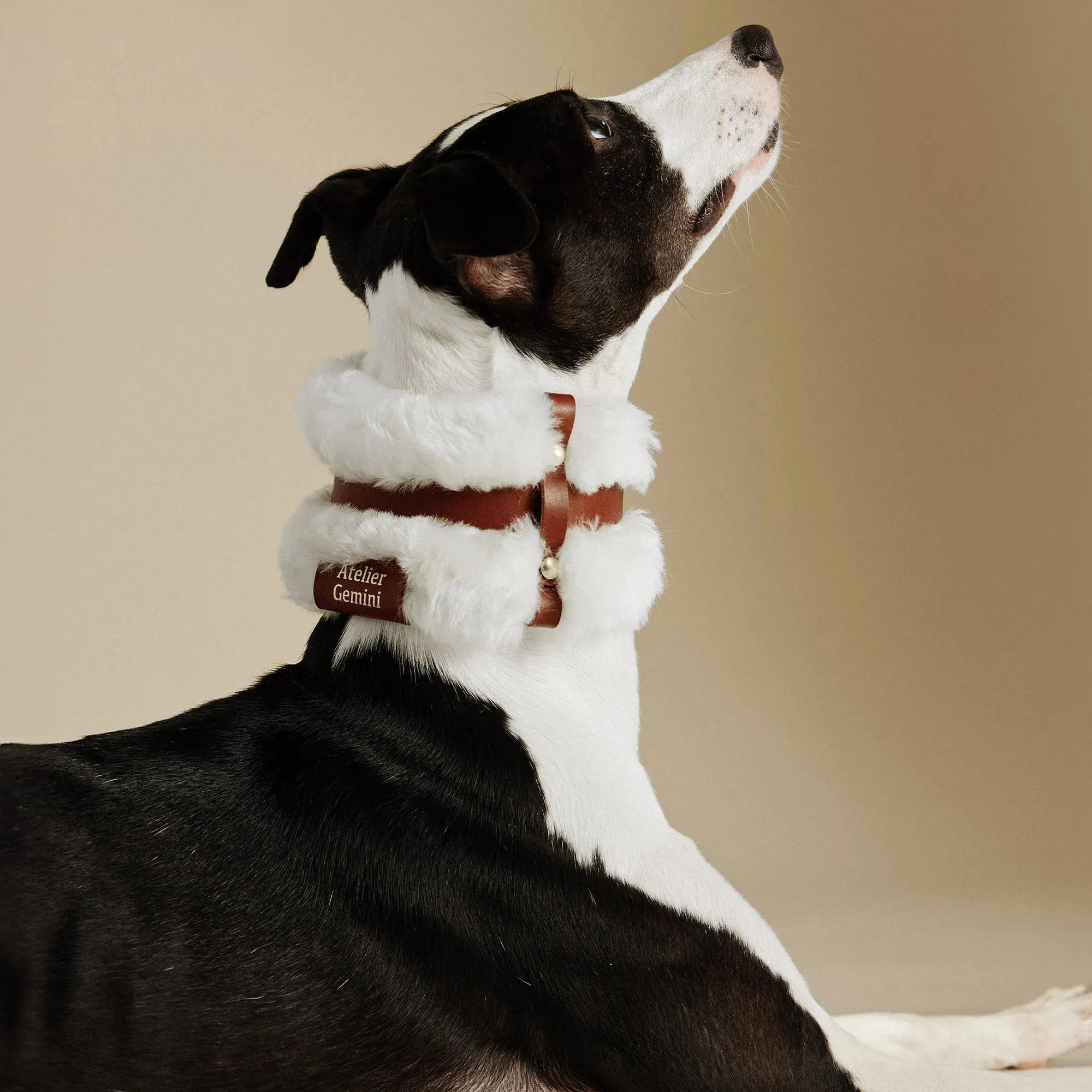
Lamb's Wool vs. Synthetic Furs
Thermal Properties of Natural Wool
Now we're getting into a fascinating subject. Lamb's wool has thermal properties that synthetic fibers simply cannot replicate.
The very structure of the wool fiber: microscopic scales that trap air. This trapped air acts as a natural thermal insulator. The more trapped air, the better the insulation. That's why quality wool sweaters are so warm.
The lamb's wool used in our collars comes from lambs less than a year old. The fibers are finer, softer, and denser than the wool of adult sheep. The result: superior insulating capacity in a more compact volume.
Lambswool insulates 65% better than synthetic fleece of equal thickness.
Breathability and Moisture Regulation
But insulation alone isn't enough. A material that retains heat but traps moisture creates a damp environment. Uncomfortable. Prone to skin irritation.
Lambswool has the unique ability to absorb up to 30% of its weight in moisture while remaining dry to the touch. Your dog's perspiration is absorbed by the fibers and then gradually wicked away.
Synthetic fur? It absorbs almost nothing. Moisture remains trapped between the skin and the material. After an active walk in winter, your dog will sweat slightly (yes, even in winter). With synthetic fur, this moisture cools down quickly. With wool, it's managed naturally.
"Lamb's wool naturally regulates temperature and humidity around the dog's neck, creating an optimal microclimate regardless of physical activity."
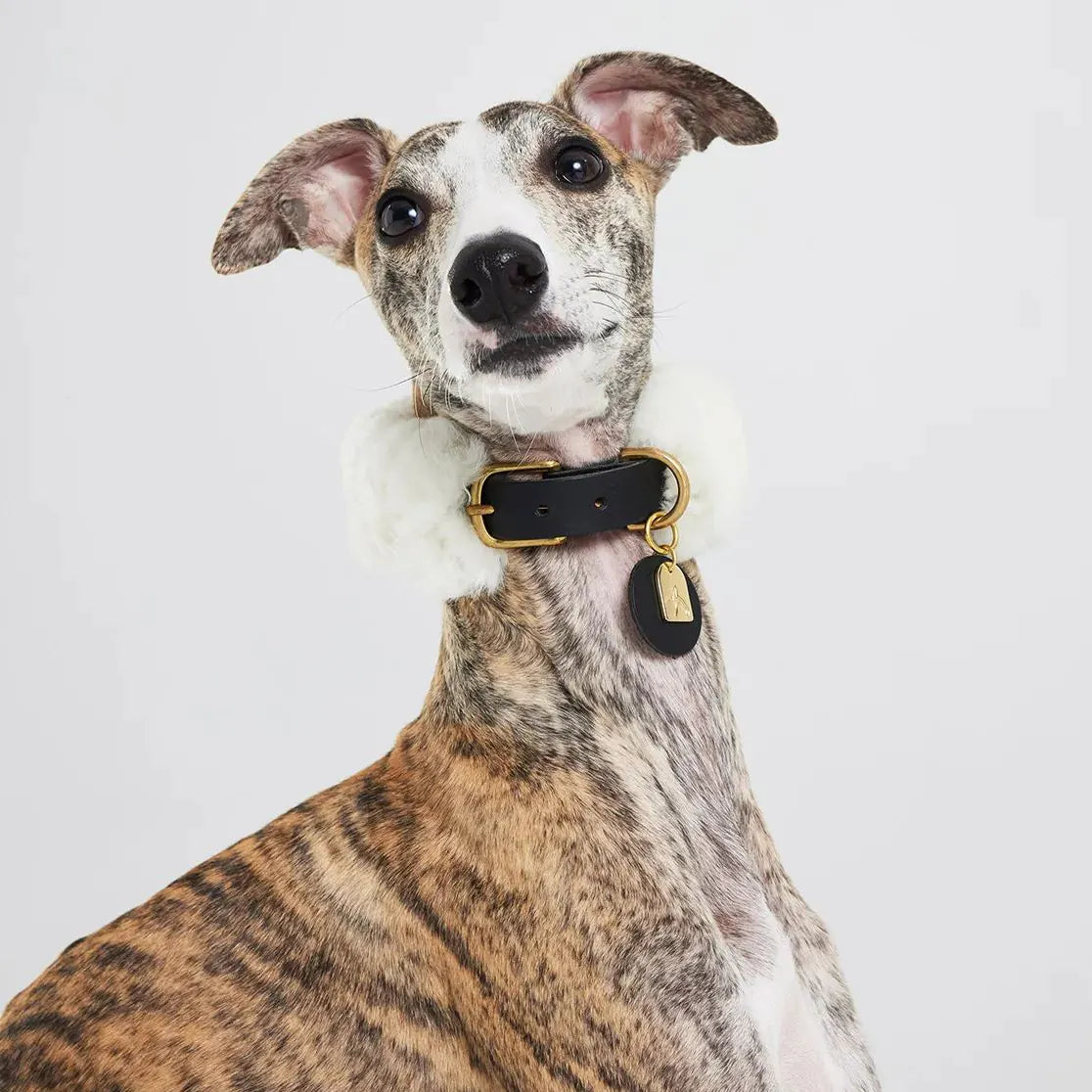
Wool also possesses natural antibacterial properties thanks to lanolin (a natural wax present in the fibers). The result: less odor, even after several weeks of daily use. Whereas synthetic fur starts to smell bad after just a few days.
Italian Leather + Wool Necklace: The Perfect Duo
Vegetable-tanned Tuscan leather as a base
We don't skimp on the quality. Our fur collars use the same full-grain Italian cowhide as our standard models. Vegetable-tanned in Tuscany using traditional methods. Supple, durable, and ages beautifully.
Why is this important even for a winter collar? Because the leather has to withstand harsh conditions: cold rain, snow, and constant humidity. Poor-quality leather will stiffen, crack, and lose its suppleness.
Vegetable-tanned Italian leather remains supple even when wet. It dries without deforming. The natural tannins (chestnut, oak) offer natural protection against moisture and mold.
Two colors are used for these winter necklaces:
- Caramel brown : A warm shade obtained with chestnut bark. Develops a magnificent golden patina over time.
- Deep black : Obtained with acacia tannins. Elegant, timeless, better masks winter dirt.
Fur Attachment: A Traditional Technique
The lamb's wool is attached to the collar using a technique that took two years to perfect. The challenge? To create a secure attachment while keeping the fur removable for cleaning.
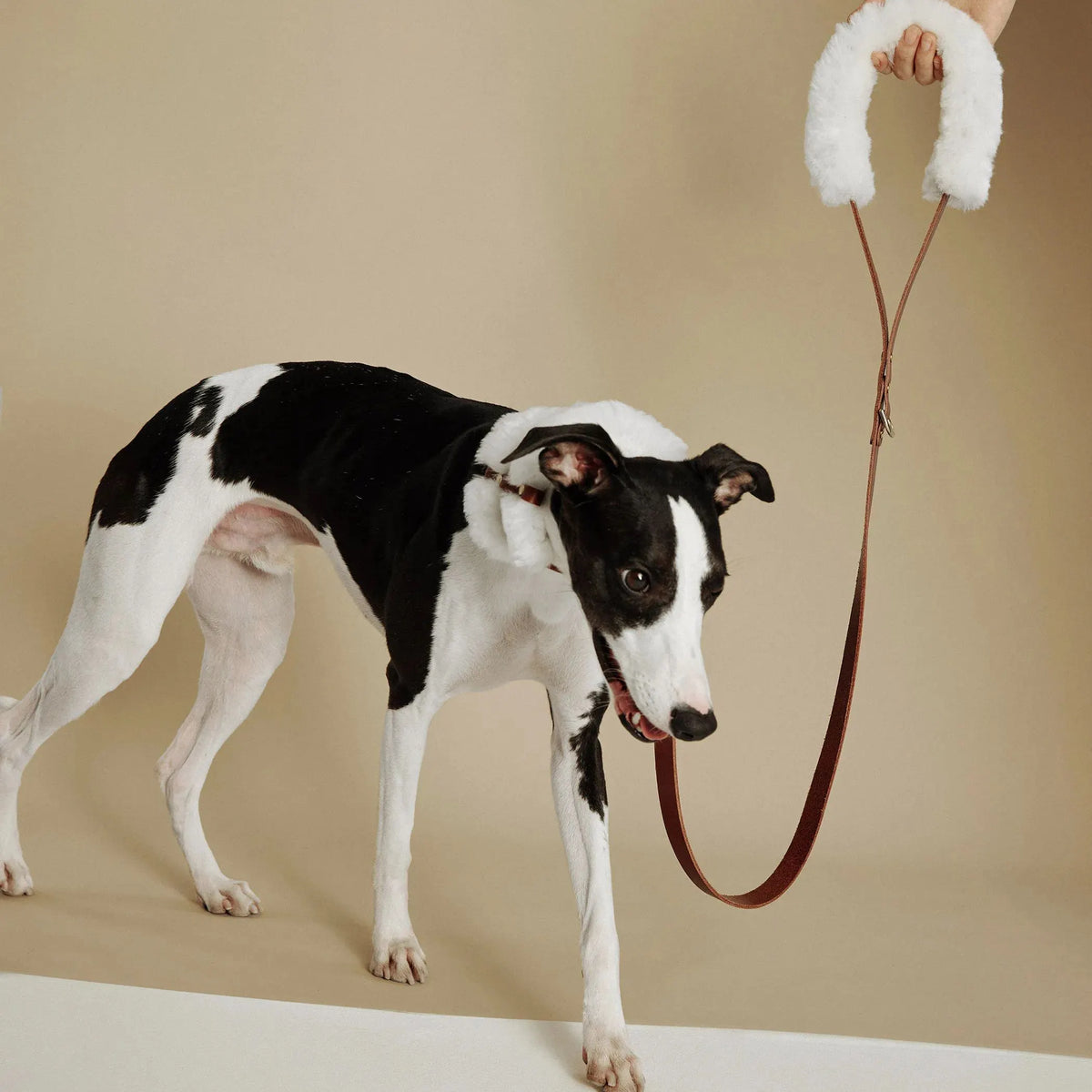
Our system: a roll of lamb's wool held in place by hand-stitched leather loops. The wool does not directly touch the seams (which could damage it), but it remains firmly in place during use.
Advantages of our system:
- Removable : Remove the fur in 10 seconds for cleaning or warm weather
- Durability : Even if your dog pulls hard, the wool stays in place
- Fit : The wool naturally adapts to the neck by compressing slightly
- Durability : No premature wear of the fibers thanks to the protective loops
The loops are sewn with waxed linen thread (the same thread we use for our equestrian saddles). Breaking strength: 25 kg. More than enough, even for large, energetic dogs.
Two widths: 7.5cm or 12cm?
We offer two models of fur collars, each with its own specific characteristics.
7.5cm Model - The Discreet and Effective
Price: €98 (sizes S and M)
- Total width: 7.5cm of leather and wool
- Weight: 85g (size M)
- Ideal for: Medium-sized dogs with medium necks
This model offers excellent thermal protection in a more compact size. Its 7.5cm width provides good coverage of the carotid arteries without being too visible under a dog coat.
12cm Model - Maximum Protection
Price: €108 (S), €118 (M)
- Total width: 12cm of leather and wool
- Weight: 140g (size M)
- Ideal for: Large Greyhounds, dogs with long and thin necks
This wide model offers maximum thermal coverage. It is particularly suitable for Greyhounds, whose long, thin necks lose a lot of heat. The 12cm width protects a much larger area.
Breed Selection Guide
Recommended breeds for the 7.5cm model:
- Whippet (medium neck)
- Podenco medium
- German Pinscher
- Boxer
- Braque
- French Bulldog (reinforced cervical protection)r
Whippets and short-haired hunting dogs particularly appreciate this model: their very thin necks stay nice and warm during winter walks without the imposing bulk of the 12cm model.
Recommended breeds for the 12cm model:
- Greyhound
- Italian Greyhound
- Azawakh
- Saluki
- Galgo
- Chart Polski
For Greyhounds with their exceptionally long and thin necks, this wide model offers maximum thermal coverage that truly protects the entire sensitive area exposed to the cold.
If you're unsure, measure your dog's neck circumference and contact us. We'll advise you on the most suitable model.
Available sizes:
- S: 18-26cm neck circumference (dogs 5-15kg)
- M: 24-32cm neck circumference (dogs 12-25kg)

Winter Care: Leather + Wool
Leather Care in Winter Conditions
Winter puts leather to the test. Rain, snow, de-icing salt, mud... Your collar will go through it all.
Recommended maintenance routine:
After each outing in the rain or snow:
- Remove the wool roll
- Rub with a slightly damp cloth
- Allow to dry naturally (never on a radiator)
Once a month:
- Clean with a slightly damp cloth
- Nourishing with natural balm (beeswax + coconut oil)
- Application in circular motion
- Leave to penetrate for 20 minutes
- Wipe off the excess
Italian leather remains supple even in winter thanks to its dense fibrous structure. However, it still benefits from regular conditioning to compensate for exposure to moisture.
Fur Cleaning
Lamb's wool has this magical property: it's self-cleaning. The wool fibers naturally repel dirt and bacteria thanks to lanolin.
Lamb's wool care:
Monthly brushing : A quick brush with a soft brush once a month is sufficient. Brush in the direction of the fur to remove dust and small debris.
Ventilation : Leave the wool roll in the open air for 24 hours every two months. The fibers will regenerate naturally.
Washing (if absolutely necessary) : Warm water + mild soap such as Marseille soap. Rinse thoroughly. Dry flat away from any heat source. Maximum twice per winter.
High-quality lambswool can last 4-5 years with minimal maintenance. That's much longer than any synthetic fur, which loses its properties after one winter.

"The combination of vegetable-tanned Italian leather and natural lambswool creates a winter necklace that transcends seasons without losing its comfort, elegance, or insulating properties."
Style and Elegance: A Winter Necklace That Makes a Statement
Let's be honest: aesthetics matter. Your dog deserves to be beautiful, even (especially?) in winter.
Our fur collars have that little something extra. They're not just a functional accessory. They're a true style statement.
Natural lambswool has that inimitable creamy beige hue. Soft and warm, it contrasts beautifully with caramel brown leather or deep black. The result: a collar that turns heads on winter walks.
The hand-stitched leather loops add a visible artisanal touch. You can see that it's handmade. That each necklace is unique. The slight variations in the leather's color, the small natural imperfections in the wool... That's what gives it all its charm.
And then there's the patina. Over the months, the leather develops those golden hues characteristic of vegetable tanning. The wool gently molds to the shape of your dog's neck. The collar becomes truly personal, unique.
We regularly receive messages from customers sending us photos after one, two, or three winters. The necklaces are magnificent. They've aged gracefully. Even more beautiful than the day they were made.

FAQ Fur Necklace
1. At what temperature does my dog need a fur collar?
For short-haired breeds (Greyhounds, Whippets, Podencos), a fur collar becomes useful as soon as temperatures drop below 10°C (50°F). Below 5°C (41°F), it becomes highly recommended. If your dog is shivering, cowering, or refusing to go outside, it's a sign that he's cold.
2. Can lamb's wool cause allergies?
Allergies to natural wool are extremely rare in dogs (less than 0.3% of cases). The natural lanolin present in wool even has soothing properties for the skin. If your dog has previously shown allergic reactions to synthetic materials, natural wool is often better tolerated.
3. Can I leave the fur collar on all day?
Yes, absolutely. Our collars are designed to be worn continuously during the cold season. The wool is breathable and won't cause overheating indoors. You can remove the wool roll if you go into a very warm environment and keep just the leather collar.
4. How do I know which width to choose between 7.5cm and 12cm?
General rule: if your dog has a long, thin neck (Greyhounds), choose the 12cm size for maximum protection. If your dog has a medium or thick neck (Whippet, Boxer), the 7.5cm size will be perfect. If you're unsure, contact us with a photo and measurements, and we'll advise you.
5. Is the fur collar resistant to snow and rain?
Yes. Vegetable-tanned Italian leather is highly resistant to moisture. Lambswool can absorb up to 30% of its weight in water while remaining insulating. After a walk in the rain, simply remove the fur and let it air dry. The leather can be wiped with a dry cloth.
6. How long does a fur collar last?
Italian leather: 8-10 years minimum with normal care. Lambswool: 4-5 years before slightly losing density. We offer replacement wool rolls (contact us) to extend the total lifespan to 10+ years. It's a true long-term investment.
7. Can I personalize the fur collar with my dog's name?
Yes! We offer hot foil stamping on the leather (before the fur is attached). The name is engraved in gold lettering on the visible part of the leather. Add this option when ordering. Please allow an additional 2-3 days for personalization.
8. My dog wears a winter coat, is a fur collar really necessary?
Even with a coat, the neck area often remains exposed (except for coats with high collars, which are rare). A fur collar perfectly complements a coat by specifically protecting this sensitive area where the carotid arteries pass. It's the ideal combination for complete thermal protection.
Ready to give your pet the winter comfort they deserve?
Winter is coming. Your short-haired dog deserves to enjoy its walks without shivering. Our leather collars with lambswool were designed for just that: combining maximum thermal protection, handcrafted comfort, and timeless elegance.
Discover our fur collars