
Last Thursday. A customer sent us a message with photos. Her brand-new necklace, bought for €89 three weeks earlier. "Look, it says 'premium leather' right there on the label." Except the necklace was already cracking. Three weeks! I zoomed in on the photos, analyzed the details for ten seconds. Bingo. All the red flags of a poorly disguised fake premium item.
You know what annoys me the most? It's not the necklace itself. Bad products exist, that's life. No, what frustrates me is this customer who sincerely believed she was buying quality. She read the descriptions. Compared prices. Trusted the seller. And she got ripped off.
The market is flooded with so-called premium collars. But what about a truly handcrafted collar versus a disguised, mass-produced copy? The difference is enormous. Not just in terms of durability, but in absolutely everything – the comfort your dog experiences, how the leather ages and changes, that feeling of wearing something authentic that can be passed down.
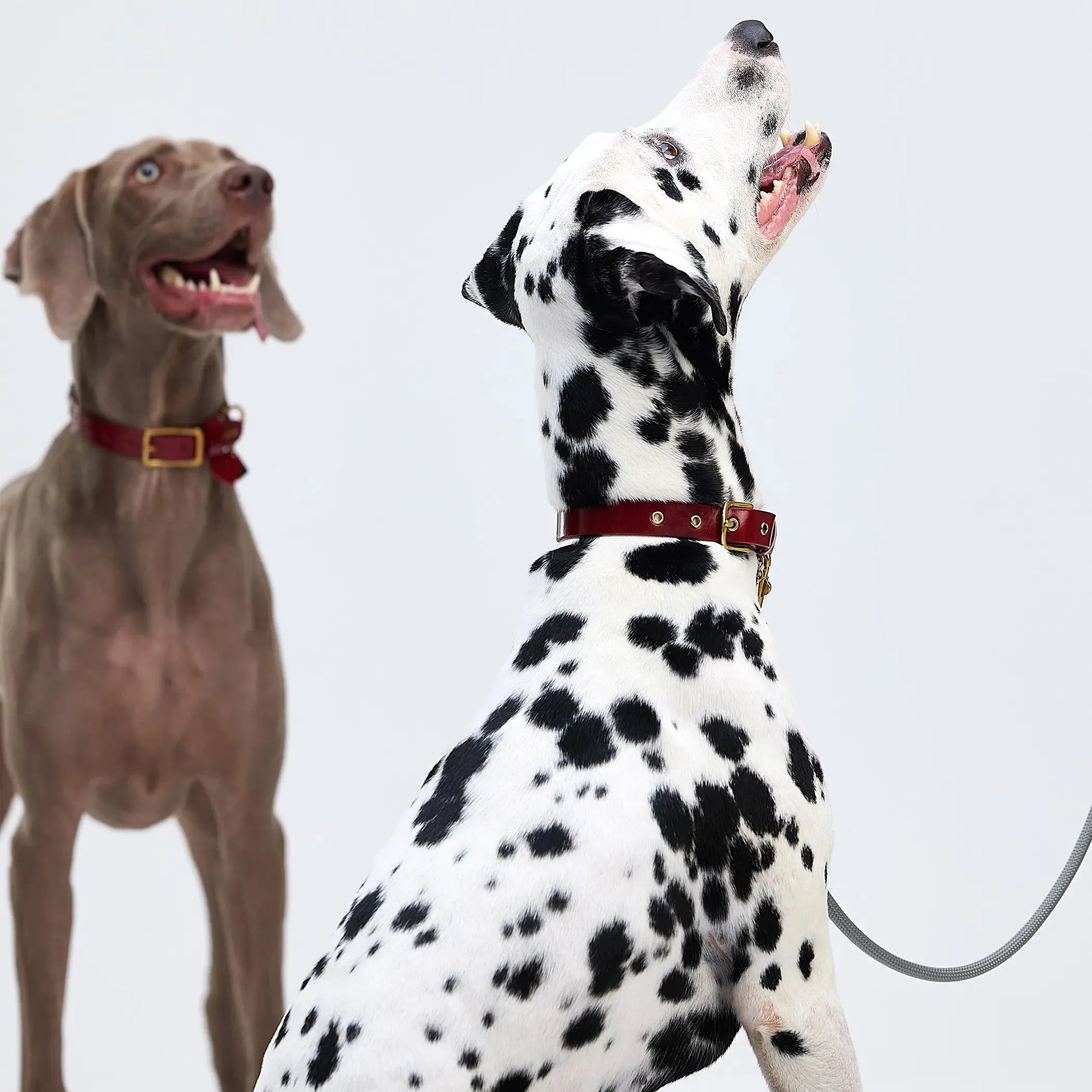
I've been working with leather for fifteen years now. My eye has become trained. I can instantly spot a quality collar versus a scam. Today, I'm sharing with you these seven criteria that make all the difference. The ones no marketer can fake. The ones that separate the real from the fake.
The 7 Infallible Criteria of a Premium Necklace
Criterion #1: Leather Type (Full Grain vs. Split Grain)
We'll start with the heart of the matter: the type of leather used.
Imagine an animal hide like an onion – several layers stacked on top of each other. The very top layer, the one exposed to the air and sun while the cow was alive, is called the bloom. Or full bloom, to be precise. This layer is pure gold. Incredibly dense. Naturally resilient. Full of those little imperfections that give it its charm – an irregular grain, sometimes an old scar, clearly visible pores. It's this layer that produces necklaces that last twenty years.
Now, beneath this top layer, you have other layers. Less refined. This is called the leather split—those inner pieces that are left over after removing the beautiful outer layer. Much less dense. Much less durable. Factories love the split: ridiculously cheap, easy to sand to hide holes, and takes any uniform dye.
"Full-grain leather retains all its natural pores and original fibrous structure, guaranteeing a durability 5 to 10 times greater than reconstituted split leather."
How can you tell them apart in a store? Get close. Look at the surface really closely. Full-grain wood shows a grain that varies slightly—some areas more pronounced, others smoother, perhaps an old, healed scratch. That's normal. It's alive. It's real. But what about crust? The surface is far too uniform, too perfect, often with a vaguely plasticized look that betrays chemical treatments.
Run your finger over it. The full-grain rind has substance; it resists slightly under pressure but remains supple. The rind feels softer, lacking this characteristic resistance.

Indicative price of premium full-grain leather: €15-25 per square decimeter (before processing). Split leather: €3-6. You can see why some collars sell for €25 and others for €80.
Criterion #2: Tanning (Vegetable vs. Chrome)
Tanning is the process that transforms raw hide (perishable) into leather (rot-proof). Two methods dominate the market.
Traditional vegetable tanning : The hides soak for 30 to 60 days in baths of crushed bark (chestnut, oak, mimosa). The tannins slowly penetrate the fibers. The result: a leather that breathes, ages beautifully, and develops a patina. High cost, lengthy process, and artisanal expertise required.
Industrial chrome tanning : Hides are immersed in chromium salts for 24 hours. Fast, economical, efficient. The result: leather that ages less gracefully, may contain chemical residues, and has less "life." But 80% of the world's leather is chrome-tanned because it's profitable.
What's the difference for your dog? Vegetable-tanned leather is hypoallergenic. Zero risk of skin reaction. Chromium? Some sensitive dogs develop redness on their necks. Not all, but it happens.
How to tell the difference? Smell the leather. Vegetable tanned leather has an organic, slightly woody, natural scent. Chrome tanned leather sometimes smells a bit chemical. Also, look at the edge (the cut edge of the leather). Vegetable tanned leather: beige/light brown edge. Chrome tanned leather: bluish edge.

At Atelier Gemini, we exclusively use vegetable-tanned leather from Tuscany. Why Tuscany? Because it's there, since the Middle Ages, that master tanners have perfected this technique. Some of the tanneries we work with have been around for three centuries. Three centuries! This expertise isn't something you can just invent overnight.
Criterion #3: Leather Thickness (3-3.5mm Optimal)
A third criterion that is often overlooked: thickness.
If it's too thin (less than 2.5mm), the collar lacks structure and will quickly deform. If it's too thick (more than 4mm), it becomes stiff, uncomfortable, and takes too long to soften.
The ideal thickness for a dog collar? Between 3 and 3.5mm. That's the sweet spot. Robust enough to last for years. Flexible enough for immediate comfort.
Cheap collars often use 2mm leather or less. They save on material, but this comes at the cost of durability. I've seen 2mm collars break clean off after six months of use by an energetic Labrador.
How to measure? If you have calipers, perfect. Otherwise, compare by touch with a reference object. A €2 coin is 2.2mm thick. The leather of the collar should be slightly thicker.

Customizable Premium Leather Necklace
3mm full-grain Italian leather, hand-stitched saddle, solid brass hardware. Hot foil stamping included.
Discover this modelAlso consider the uniformity of the thickness. Quality leather has a consistent thickness along its entire length. Cheaper leathers sometimes have thinner areas (to save material) which become weak points.
Criterion #4: Sewing (Hand Saddler vs. Machine)
Let's move on to the seams. A crucial detail that many neglect.
Hand-stitched saddle stitching : Each stitch is made with two needles simultaneously, forming a cross stitch. Waxed linen thread is used, with a tensile strength of 25 kg. This is a slow, traditional leatherworking technique. If one stitch breaks (due to extreme wear), the others remain. The collar will not come undone.
Standard machine sewing : Fast, economical, and neat. But it uses a single loop of thread. If the thread breaks somewhere (due to friction or tension), the entire seam can unravel, just like a zipper.
Look closely at the stitches. Hand stitching: slightly irregular stitches (this is normal, it's done by a human), angled at approximately 45°, and deeply embedded in the leather. Machine stitching: perfectly regular, perpendicular stitches, sometimes slightly superficial.
"Hand-sewn saddle stitching guarantees three times the mechanical resistance of industrial machine stitching and allows for localized repairs impossible with automated techniques."
At our workshop, all the stitching is done by hand. Each necklace takes between 45 minutes and 2 hours to make, depending on its complexity. It's a long process. But that's what allows an Atelier Gemini necklace to last ten years without a single stitch coming undone.

Criterion #5: Hardware (Solid Brass vs. Zamac)
Buckles, rings, rivets. That's called hardware. Huge difference between high-end and low-end.
Solid brass : An alloy of copper and zinc. Heavy, strong, and develops a natural patina over time. Never rusts. Does not break. High cost. It has been used in luxury leather goods for centuries.
Zamac (or zinc/aluminum alloys): Lightweight, brittle, corrodes with moisture and salt. Often plated with gold or nickel to imitate brass. The plating wears off in a few months. Very low cost.
How to tell them apart? Weight first. Solid brass is noticeably heavier. Simple test: tap the buckle with your fingernail. Solid brass = a dull, full sound. Zamac = a hollow, metallic sound.

At Atelier Gemini, all our hardware comes from Italian foundries specializing in solid brass. The buckles are cast and then hand-polished. Each ring can withstand 50kg of tension without deforming.
Criterion #6: Slice Finishes
The edges are the sides of the leather. A detail that no one notices. Yet, it instantly betrays the quality.
Handcrafted finishes : Edges finely sanded, stained or waxed, polished with a cloth. Smooth, slightly glossy appearance, pleasant to the touch.
Industrial finishes : Edges left raw or roughly painted. Fibrous, rough appearance. Paint wears off quickly.
Run your finger along the edge. If it's soft and smooth: good finish. If it's rough: sloppy finish.

Criterion #7: Warranty and Durability
Final criterion: what does the manufacturer guarantee?
High-end brands stand behind their quality. 2, 3, sometimes 5 year warranties. Repairs available. Responsive customer service.
A truly high-quality, handcrafted collar should last at least 8-10 years with basic care. I have clients whose dogs have been wearing our collars for over a decade.
"A handcrafted, vegetable-tanned, full-grain leather collar with traditional finishes can last your dog's entire life, developing a unique patina that tells your shared story."
Let's do the math together. A basic collar costs €25 and needs replacing every 18 months. Over 10 years: 7 collars = €175. A high-end collar costs €80 and lasts 10+ years. Even from a purely economic standpoint, the high-end collar is more cost-effective.

Leather and Lambswool Collar
Premium winter comfort: Tuscan leather + natural lambswool. Removable fur. Ideal for short-haired dogs.
See the winter modelItalian Leather vs. Other Origins: The Honest Comparison
Italian leather (Tuscany) : A tradition of vegetable tanning spanning eight centuries. Rigorous selection of hides. High price, but justified. This is what we use at Atelier Gemini.
French leather : Very good quality for equestrian saddlery. Slightly more expensive than Italian leather. Limited availability.
Indian/Pakistani leather : Variable quality. Often chrome-tanned. Attractive prices but risks.
Tuscany remains the world's benchmark for luxury leather. Hermès, Louis Vuitton, and Prada source their leather there.
We make two trips a year to Tuscany to inspect our shipments directly from our partner tanneries.
Justified Pricing: Understanding Price Ranges
€40-70: What You Really Get
Good quality full-grain leather, possibly mixed tanning, quality machine stitching, good quality brass or zamac hardware. Lifespan: 4-6 years.
€70-150: The Sweet Spot - Quality/Price
Our Atelier Gemini range (€40-90). Italian cowhide leather, vegetable tanned, hand-stitched, solid brass, hot foil stamping for personalization. Lifespan: 8-12 years.

€150-300: Is Ultra-Premium Justified?
Exotic leathers, gemstone inlays, limited editions. For 95% of owners, it's disproportionate. You're mainly paying for brand prestige.
Pitfalls to Avoid (Fake High-End)
The "Genuine Leather" Trap
"Genuine leather" is the LOWEST grade of leather. It's reconstituted split leather. If a collar is labeled "genuine leather," be wary. A true high-end collar will specify "full-grain leather."
The Finishes That Hide the Mediocrity
Some people apply thick layers of paint to low-quality leather. It shines at first. Three months later, it cracks.
High Price ≠ Automatic Quality
I've seen necklaces for €120 made with basic leather and cheap hardware. The high price just created an illusion of luxury.
ROI Calculation: 10-Year Investment
Scenario A: Low End
Price: €25 × 7 collars = €175 over 10 years. Fairly comfortable. 7 collars thrown away.
Scenario B: High-end
Price: €85 + €120 maintenance = €205 over 10 years. Exceptional comfort. 1 collar, repairable.
Difference: €30 over 10 years = €3/year. For unparalleled comfort and a reduced environmental footprint.
Our Atelier Gemini Selection: Accessible High-End
At Atelier Gemini, we made a choice: to make true high-end craftsmanship accessible. No compromise on quality, but a reasonable profit margin.
What sets us apart:
- Tuscan leather only : Family-run tanneries, we reject 30% of deliveries
- Traditional hot gilding : Solid brass module, gold leaf at 120°C
- Hand-sewn saddle stitching : 45 minutes to 2 hours per collar
- Custom design : Made to order
- Transparent pricing : No fake promotions
Discover our complete collection at atelier-gemini.fr/collections/collier-chien-personnalise .
To learn more about our approach, visit our About page with our manufacturing processes in pictures and videos.

Premium Black Necklace with Brass Earrings
Professional robustness: 3.5mm leather, double saddle stitching, solid brass buckles. For heavy-duty use.
See the pro modelCaring for a High-End Necklace
Monthly routine: Damp cloth, natural drying, balm (beeswax + oil), circular massage, leave to penetrate for 15 minutes.
After exposure to water: Dry immediately, allow to dry naturally (never radiator!), nourish the next day.
NEVER do: Dry in direct sunlight, place on a radiator, use non-specialized products, machine wash.
FAQ - Your Questions about High-End Products
1. How can I check if my necklace is made of full-grain leather?
Look at the cut edge. If you see distinct layers or a "sandwich" appearance, it's a stuck-on rind. Full-grain cheese is uniform throughout its thickness. Also, bend the neck of the cheese: full-grain cheese doesn't crack on the surface; it bends smoothly.
2. Is Italian leather really superior to French leather?
Both are of excellent quality. The Italian (Tuscan) excels in traditional vegetable tanning, boasting eight centuries of expertise. The French is remarkable in equestrian saddlery. For dog collars, the Italian offers the best balance of suppleness, strength, and patina.
3. How much does a high-end, handcrafted necklace actually cost?
Realistic price range: between 70 and 150 euros for truly high-end, handcrafted leather. Full-grain vegetable-tanned leather, hand-stitched details, solid brass hardware. Below 60 euros, frankly, there's no chance of meeting all these criteria.
4. Does hot foil stamping wear off over time?
No, it holds up. The hot foil stamping fuses into the leather fibers at exactly 120 degrees Celsius. Five years of daily use, even ten years – your engravings remain as precise as the first day.
5. Why choose solid brass?
Solid brass never rusts. It doesn't break. It can withstand fifty kilos of tension without even deforming. Zamac-plated brass corrodes as soon as there's any moisture, and it breaks under heavy stress. For a collar meant to last a decade, solid brass is the only reliable choice.
6. Is a high-end collar suitable for all dogs?
Absolutely. From the tiniest Chihuahua to the giant Great Dane. What matters is adapting the width and thickness. Small (under 10kg): 15-20mm. Medium (10-25kg): 25-35mm. Large (25kg+): 35-50mm.
7. How to recognize genuine hand-sewn saddle stitching?
The stitches show slight irregularities – normal, they're made by hand. They're angled at around 45 degrees. They're firmly embedded in the leather with two clearly visible parallel grooves. Run your fingernail over them: the hand stitching is deeper.
8. Does vegetable tanning really make a difference?
Absolutely. Vegetable tanning is hypoallergenic, with no chemical residue. For dogs with sensitive skin – Bulldogs, Greyhounds, some Terriers – it completely prevents redness on the neck.
9. Can a handmade necklace be repaired?
Yes, and that's a huge advantage. A stitch comes undone? We'll fix it. A buckle is damaged? We'll replace it. Scratched leather? We can sand it and re-dye it. A good handcrafted necklace can be repaired.
10. Does the patina of the leather change the aesthetics?
Absolutely. Vegetable-tanned leather develops golden hues. Areas become darker where it rubs. After two or three years, your necklace tells a unique visual story.
Your Dog Deserves the Best
Now you know how to recognize a truly high-end necklace. The seven criteria, the pitfalls to avoid, the justified prices. Ready to invest in a necklace that will stand the test of time?
Discover our collection