
Okay, listen. You hunt. Your dog does too. And you're tired of having to buy a new collar every six months because it broke during a hunt, right?
Two weeks ago, a hunting friend told me about his ordeal. His Brittany Spaniel, out hunting in the brambles near Sologne, came home without its collar. Gone. Torn off somewhere between the bushes and a river crossing. The collar? A rigid plastic thing bought for 35 euros online. Lifespan: four months. Result: the dog couldn't be identified for two hours during the hunt. Total panic.
So today, we're going to talk seriously about custom hunting dog collars . Not the usual sales pitch. No. We're going to compare what actually exists in the field: vegetable-tanned leather, reinforced nylon, and fur for sensitive breeds. Because frankly, there's a world of difference between what they sell you and what actually holds up in real-world conditions.
I'm not going to lie to you: the leather costs more initially. But when you calculate it over five years of hunting, then we'll talk about the price again. I promise.
Why the Material Changes Absolutely Everything in Hunting
Let's be clear. A **collar for a hunting dog** is not a collar for a Sunday stroll in the municipal park.
Your dog runs through brambles that tear your own clothes. He dives into icy pools in November. He pulls like crazy when he smells game. He rolls around in... well, you get the picture. And he does this for hours. Sometimes all day.
My brother-in-law has been hunting wild boar with his Griffon for fifteen years. He explained something simple to me: "A collar that breaks during a hunt isn't just 60 euros lost. It's your dog that could run off 3 kilometers, cross a road, and..." He didn't finish his sentence. No need.
The material isn't just an aesthetic detail. It's about your dog's safety. Period.
 Watch this German Shorthaired Pointer in action. Stubble field, autumn, real hunting conditions. His collar has to withstand hours in this kind of terrain. The dry stalks that snag, the dust, the sudden movements when he charges. That's exactly why we talk about durability. A low-quality collar wouldn't last two outings in these conditions.
The Three Criteria That Really Matter
So, what makes a necklace hold up or not?
Pure, unadulterated strength . Thorns, snagging branches, violent tugs when the dog charges. If it breaks, you're in deep trouble. I saw a cheap nylon collar snap clean off on a Setter that was chasing a dog. Clearly not strong enough for a 25-kilo dog charging at full speed.
Comfort for your dog's skin . Do you wear your hunting collar for eight hours? No. He does. If he's scratching every five minutes because it's irritating, it's a lost cause. My former neighbor had a Beagle with a rigid synthetic collar. The dog developed a wound on its neck after only three outings. The result: vet visit, antibiotics, and three weeks without hunting.
Post-outing maintenance . Because frankly, after a hunt where your dog is covered in mud, game blood and stagnant water... you don't necessarily want to spend two hours cleaning his collar.
Reinforced Nylon: Lightweight and Practical (But...)
We start with this one because it's often the first choice when starting out in hunting.
Nylon is lightweight. It's inexpensive (generally between 35 and 50 euros). And it's available in all colors, including fluorescent ones that let you spot your dog from 100 meters away in the undergrowth.
What Works With Nylon
So yes, nylon has concrete advantages.
It's ultra-light . For small hunting dogs like Beagles or small Spaniels, that's a real plus. A collar that weighs next to nothing makes all the difference for a 12-kilo dog that runs around all day.
It's moisture-resistant . Mind you, I didn't say waterproof. But it dries quickly. Your dog crosses a river? The collar will be dry in an hour. Practical.
High-visibility colors . Fluorescent orange, fluorescent yellow, fluorescent green... frankly, for safety during a hunt, it's fantastic. You spot your dog immediately, even in dense vegetation.
 A perfect example of visibility. This Weimaraner is wearing a fluorescent green outfit. In dense undergrowth or during a driven hunt, you can spot him from 100 meters away. This is crucial for safety. Other hunters see him too, which helps prevent accidents. The fluorescent color isn't just for show; it's for safety. For nylon, this is one of its major advantages: all colors are available, even the brightest.
But beware: Not all nylons are created equal
Okay, let's be honest. Classic flat nylon webbing isn't great.
They fray . Basic, flat-cut nylon cable ties wear out quickly. The threads come loose at the seams, it looks unsightly, and most importantly, it loses strength. I've seen low-end nylon cable ties that barely lasted two years with heavy use.
The resistance is limited with flat straps . For a large, powerful dog that pulls really hard, the classic nylon webbing can break, especially at the seams. This has happened several times: the collar snaps when the dog charges.
However – and this is where it gets interesting – circular cut nylon ropes are a completely different story .
Braided Nylon Rope: The Real Hunting Nylon
Listen, you mustn't confuse the nylon webbing that you find everywhere with the braided nylon rope specifically designed for hunting.
Circularly cut ropes are much stronger . Why? Because the contact surface with brambles and branches is reduced. Instead of rubbing against a flat surface, only a circular section is exposed. As a result, they wear out much less quickly.
But be careful. Weaving these ropes requires real expertise. Poorly braided, it becomes stiff and irritates the dog's neck. Well braided, with a solid stitched assembly using quality leather... then you have a collar that will last.
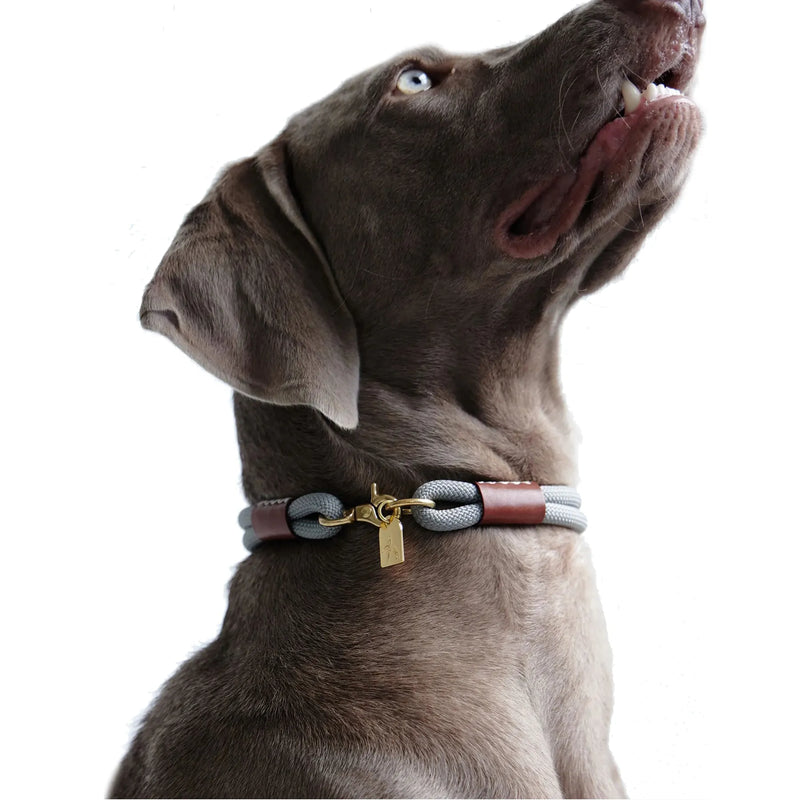
Custom-Made Hunting Collar in Braided Nylon Rope
This model perfectly illustrates what I'm talking about. Look at the quality of the circular braiding. The leather is securely stitched, not glued. This Labrador has been wearing it for months in real-life conditions. It really holds up.
Discover this necklaceThat's why it's essential to choose a nylon collar specifically designed for hunting dogs . Not some generic 15-euro thing. A real braided rope, well-made.
 See those braided nylon cord collars? They come in several sizes, all with the same circular braiding system. The white pieces are sewn, not glued. The tag is securely riveted. This is exactly the kind of construction that makes the difference between a collar that lasts two seasons and one that lasts ten. The high-visibility green cord is perfect for hunting in dense woods.
High-quality medal engraving . Engraving directly onto nylon cord is impossible. But with a solid brass medal, securely riveted (not glued), you have lasting identification. More on that below.
Nylon: Who Is It Really For?
Braided nylon rope is a good choice for hunters who want something lightweight, durable, and less expensive than leather. If you hunt regularly, have a medium-sized dog (Beagle, Spaniel), and choose REAL quality (circular rope, stitched construction)... nylon will do the job very well.
Just avoid basic nylon webbing. That's fine for a Sunday stroll, not for hunting.
Vegetable-Tanned Leather: The Smart Investment
Now we're getting into the serious stuff. Vegetable-tanned leather is a completely different world from the chrome-treated industrial leather you find everywhere.
My upstairs neighbor, a hunter for thirty years, explained the difference to me one evening over a beer. "Vegetable-tanned leather is tanned with oak and chestnut bark. It takes six to eight weeks. Chrome-tanned leather? That's done in 24 hours in chemical baths. You can feel the difference immediately."
Why Vegetable Leather Is Something Else
It breathes . Really. Vegetable-tanned leather wicks away moisture naturally. The result: under the collar, the dog's skin stays dry. No maceration, no irritation, no lingering odors.
It gets even more beautiful with age . Seriously. The leather develops a patina. It darkens slightly, becomes more supple, and molds to the shape of your dog's neck. I saw a five-year-old Setter's collar. It was stunning. Impossible to replicate on a new one.
It lasts ten to fifteen years . Not two years. Not five years. Ten to fifteen years if you take proper care of it. We're talking about a collar your dog will potentially wear for its entire hunting life.
It's hypoallergenic . For dogs with sensitive skin, that's crucial. Vegetable-tanned leather contains no harsh chemicals. Zero chrome. Zero synthetic dyes. Just natural leather and tannins.
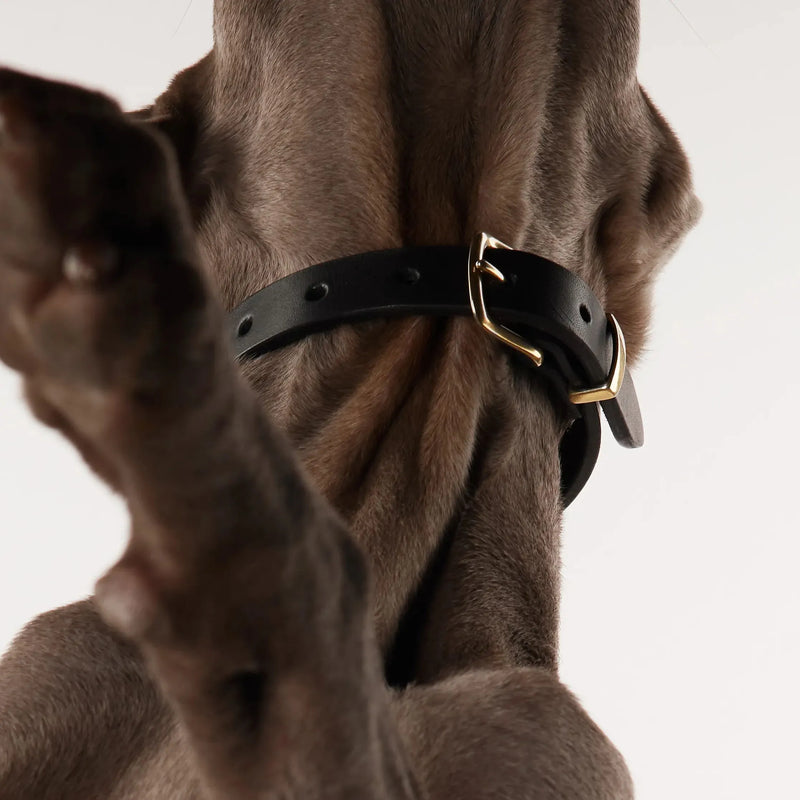
Premium Black Leather Necklace with Brass Buckles
Look at the quality of the vegetable-tanned leather. The hardware is solid brass. Not plated, which will turn green after six months. Real brass that lasts for years. This type of collar is a smart investment for a regular hunter.
See this necklaceThe Interview: Less Boring Than They Say
Okay, I'll be frank. Yes, leather requires a minimum of maintenance. But it's not complicated.
After a muddy ride, rinse the collar with lukewarm water. Let it dry at room temperature. Never put it on a radiator. It will dry it out and cause it to crack.
Two to three times a year, apply a natural grease (leather conditioning grease, you can find it everywhere for 10 euros). Rub it in, let it penetrate. It takes ten minutes.
My brother-in-law does this in front of the TV while watching the match. He tells me: "Ten minutes every two months to keep my necklace for fifteen years? That's a gift."
 Bonding and trust also depend on equipment. This Doberman jumps without hesitation because he knows his collar will hold. Imagine that kind of movement with a collar that breaks mid-air. Trust would be shattered. It's the same when hunting. Your dog must be able to rely on his collar 100%, in all his movements, even the most forceful.
Leather in Real-World Conditions
I asked several hunters who use vegetable-tanned leather. They all told me the same thing.
A hunter from Dordogne with a Brittany Spaniel: "My dog has worn the same collar for eight years. Driven hunts, undergrowth, river crossings... The leather has just darkened, it's even more beautiful than at the beginning."
Another hunter who hunts wild boar in Ardèche: "I tried nylon, it lasted two seasons. Leather? That's six years. No visible wear."
However, be careful. If your dog is a compulsive swimmer who dives into the water every five minutes, leather won't age as well. In that case, nylon is a better choice.
Fur: Functional Luxury for Vulnerable Breeds
Now we're talking about something very specific. Fur isn't necessary for all hunting dogs. But for some breeds, it's absolutely essential.
Why the Fur Hunt?
Greyhounds and similar breeds (Whippets, Galgos, some Pointers) have extremely thin skin and short coats. As a result, traditional collars cause them terrible irritation. I saw a hunting Whippet with a completely raw neck after just one season. The owner was distraught.
The fur (sheep, lamb, or high-quality synthetic) creates a soft barrier between the collar and the skin. No more rubbing. No more irritation.
Thermal insulation . In winter hunting, it matters. A collar with a fur lining keeps the dog's neck warm. For breeds sensitive to the cold, this is truly invaluable.
Traditional look . Let's be honest, a leather collar with fur trim looks impressive. It's classy. It's the kind of collar you see on the hounds of hunting packs. It has character.
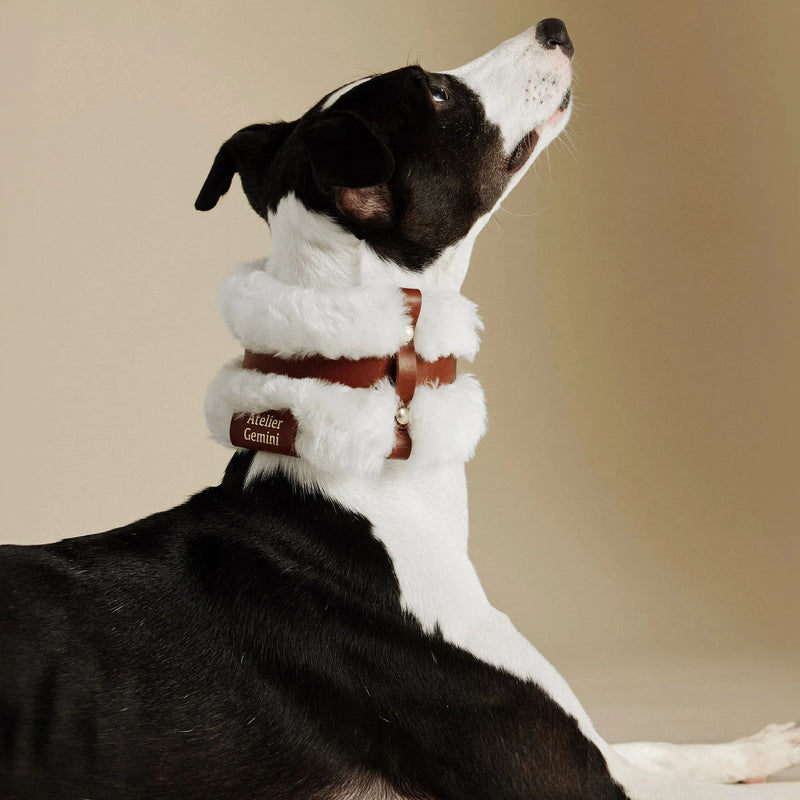
Personalized Sheep's Wool and Leather Collar
This model perfectly illustrates the idea. Look at this Whippet. The wool lining protects its delicate skin. The leather exterior ensures durability. It's the perfect combination for these sensitive breeds that hunt regularly.
Discover this necklaceNatural or Synthetic Fur?
Okay, so you have two options here.
Natural fur (sheep, lamb): It's the best. It breathes naturally. It regulates temperature. It's ultra-comfortable. However, it requires maintenance (regular brushing to prevent tangles). And it's more expensive: expect to pay 89 to 120 euros.
Synthetic fur : A cheaper alternative (60 to 80 euros). Easy to clean. Even washable. But less breathable. And less durable.
Honestly? If you have a greyhound or a breed with sensitive skin that hunts regularly, invest in natural fur. Your dog will thank you.
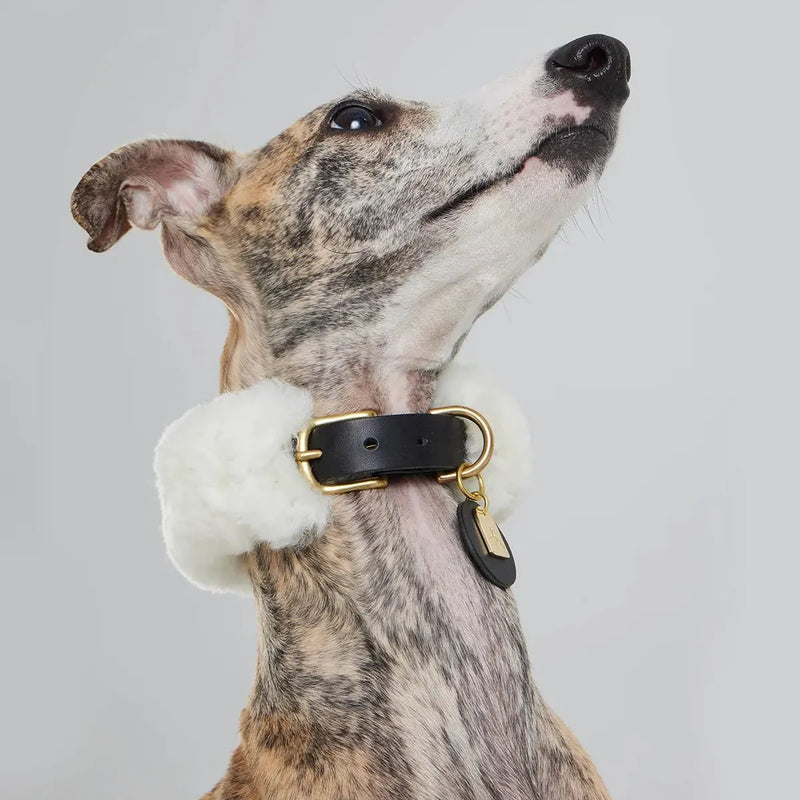
Custom-Made Leather and Wool Collar
The perfect combination: the durability of vegetable-tanned leather + the softness of woven wool. For a dog like this Whippet with sensitive skin, it's ideal. Elegant and functional at the same time.
View this modelFor Which Dogs and Situations?
Hunting sighthounds : Whippets, Greyhounds used for hare hunting, Galgos. These dogs absolutely need protection.
Dogs with fine skin : Some Pointers, some Short-haired Braques.
Winter hunting : Sub-zero temperatures, frost. Fur really insulates.
A fox hunter I know told me: "In our pack, all the dogs wear leather and fur. It's been the norm for generations. It works, why change it?"
Personalization: Engraving or Medal? Both Can Work
Regardless of the material you choose, personalization with identification is MANDATORY. Seriously.
Hot Foil Engraving: Discreet Luxury
Hot foil stamping is the Rolls Royce of personalization. The leather is marked with heated brass letters. The result is magnificent, discreet, and permanent.
 That's exactly what I mean. Look at this hot-stamped gold engraving on black leather. The initials "Ab" are embossed in heated brass. It's discreet, elegant, and it lasts for years. No wear. No discoloration. The hot stamping penetrates the leather; it literally becomes part of the material. On the other hand, to engrave "ROCKY - 06 12 34 56 78 - HUNTING DOG," you would need dozens of different letter modules. Prohibitively expensive. That's why many people choose gold stamping for the name and a medallion for the contact information.
However, let's be honest: if you want to engrave all your contact information (dog's name + address + phone number + message), it's very expensive. Each brass letter module has to be made individually, just for you. We're easily talking 150-200 euros just for the engraving.
So, hot foil stamping is great for adding the dog's name. Elegant. Understated. But for full contact information? Not practical.
The Quality Medal: It Works Too (If Well Made)
So yes, we often hear "no medals in hunting". But we need to qualify that.
A low-quality medal is definitely problematic. The ring opens, it gets lost in brambles, it makes noise. That's clear.
BUT a truly high-quality medal is another story .
 Look at this clasp. A solid brass medal, riveted with quality rivets. Not glued on with industrial adhesive that fails after three months in the rain and cold. No. Physically riveted. It doesn't budge. The joints, the rings, all solid brass. Not plated and rusting. Real brass that withstands the elements, water, mud, and extreme temperatures.
With a medal like this, you can engrave:
- Line 1 : Dog's first name
- Line 2 : Your mobile phone number
- Line 3 (on the back): Specific message if needed ("HUNTING DOG", "Medical treatment", etc.)
The huge advantage of a quality tag? You can change it . Moving house? Changing your phone number? No need to buy a whole new collar. You can just have the tag replaced for 15-20 euros. The collar itself stays.
What You Absolutely Must Avoid
❌ The plates are glued to the collar . Industrial glue doesn't withstand the elements. After a few outings in the rain, during driven hunts, in the mud... the plate comes unglued. I've seen it far too often.
❌ Cheap aluminum medals with rings . They rust, they break, they get lost. Seriously, it's throwing money away.
✅ The good options :
- Hot foil stamping (for the first name, luxury and discretion)
- Riveted solid brass medallion (for complete contact details, practical and durable)
- Combination of both (gilded name + matching medal)
In driven hunts, what really matters
If your dog gets lost and another hunter finds it, they must be able to immediately see how to contact you. Whether it's engraved or on a tag doesn't matter. What's important is that it's visible, legible, and that it doesn't come off .
A well-riveted brass medal? It'll last ten years. Really.
No identification? At best, it's off to the pound. Or worse. Don't play around with that.
The Importance of a Matching Leash
Hey, that reminds me of something we often forget.
If you're investing in a good, personalized hunting dog collar , also get a quality leash. Why? Because a leash that breaks just when you want to call your dog back after a hunt is a real pain.
 This image perfectly captures the essence of what we're talking about. A happy dog, a quality collar, a pleasant walk. It doesn't matter if your collar is leather and your leash is nylon, or vice versa. What counts is the quality of each element. A good, personalized hunting dog collar deserves to be paired with a sturdy leash, regardless of the material. Harmony comes from quality, not necessarily from a perfect match of materials.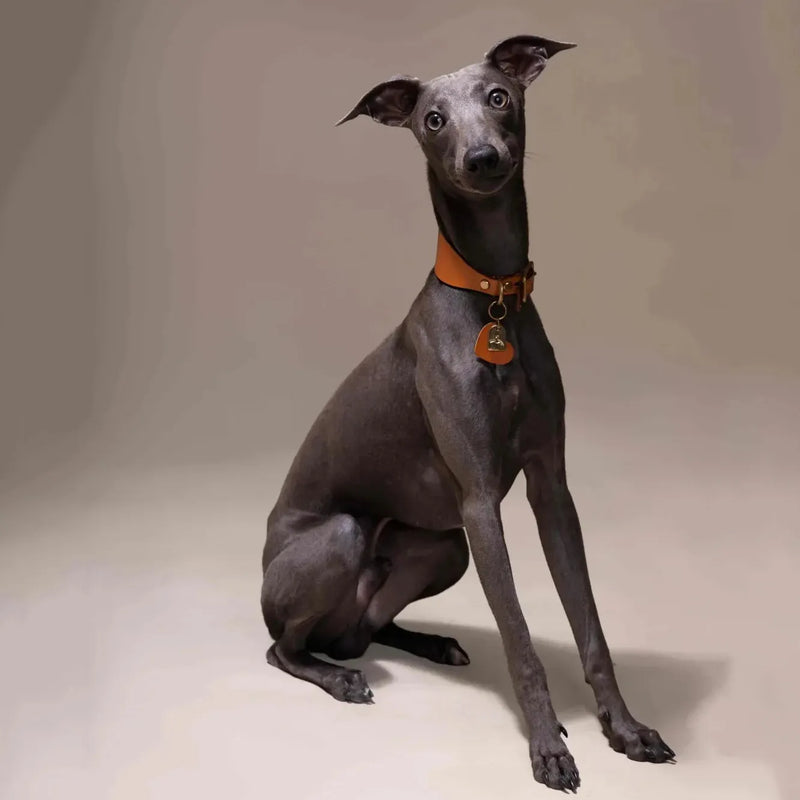
Customizable Orange Leather Necklace
Beautiful, isn't it? But also notice the consistency with the leash. Same finish, same hardware. Now that's equipment that lasts. Good hunting gear is a harmonious and durable set.
See this necklaceBy the way, you can take a look at our collection of dog leashes . Find the one that matches your collar. Because good equipment is a cohesive and durable set.
My Final Recommendation (Really Honest)
After speaking with dozens of hunters, testing different materials, and seeing collars in real-world conditions... here is my sincere advice.
For 80% of hunters : Vegetable-tanned leather is the best choice. Yes, it's more expensive to buy (€69-89). But over ten years, it pays for itself. The comfort for your dog is incomparable. And the elegant look of the leather, frankly, pleases you too.
For those on a tight budget or occasional hunters : Quality braided nylon rope will do the job just fine. Choose quality, not the cheapest option. And opt for a high-visibility color.
For greyhounds and sensitive breeds : Fur is non-negotiable. It's not a luxury, it's protection.
Check out our full collection of custom collars . We have models to suit every hunting situation, every breed, and every budget.
And most importantly, have a high-quality tag engraved or riveted onto your dog's collar. Include the dog's name and phone number. This is the absolute foundation of your dog's safety.
Your dog is counting on you. On your equipment. On your choices. A good personalized hunting collar isn't just an accessory. It's their identification, their safety, their comfort during hours of intense work.
Choose wisely. Invest intelligently. And happy hunting.